🌸 POLLINATION – EASY NOTES 🌸
💡 What is Pollination?
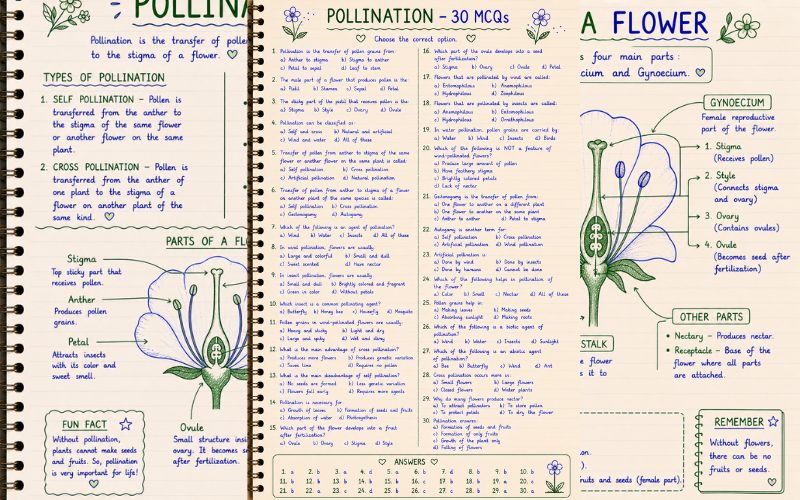
Pollination is the process of transferring pollen grains from the anther (male part) to the stigma (female part) of a flower.
👉 In short:
🌼 Pollen goes from anther → stigma
🌺 Parts of a Flower (Super Important!)
🟢 1. Calyx
- Made of sepals
- Green, leaf-like
- 👉 Protects the flower in the bud stage
🔵 2. Corolla
- Made of petals
- Bright and colorful
- 👉 Attracts insects
🌼 Reproductive Parts
🟢 Male Part → ANDROECIUM (Stamen)
- Anther → produces pollen
- Filament → holds the anther
👉 Trick: “A = Anther = Airborne pollen”
🔵 Female Part → GYNOECIUM (Pistil)
- Stigma → sticky, receives pollen
- Style → tube-like path
- Ovary → contains ovules
👉 After fertilization:
- Ovule → Seed 🌱
- Ovary → Fruit 🍎
🌸 Types of Pollination
1️⃣ Self-Pollination
- Same flower or same plant
- 👉 Less variation
2️⃣ Cross-Pollination
- Between different plants of the same species
- 👉 More variation (better!)
🐝 Agents of Pollination
🌬️ Abiotic (Non-living)
- Wind
- Water
🐝 Biotic (Living)
- Insects (bees 🐝, butterflies 🦋)
- Birds 🐦
- Animals
👉 Memory Trick:
🌬️ Wind = Light pollen
🐝 Insects = Sticky pollen
🌼 Features of Flowers
🌬️ Wind-pollinated flowers:
- Small, dull
- No smell
- Light pollen
🐝 Insect-pollinated flowers:
- Bright & colorful
- Sweet smell 🌸
- Sticky pollen
🌱 Why is Pollination Important?
✔ Helps in fertilization
✔ Leads to seeds & fruits
✔ Helps plants reproduce
✔ Maintains plant life cycle 🌍
🔥
🌼 Anther → Stigma → Fertilization → Seed + Fruit